
Venezuela has sworn in a new interim president following the arrest of Nicolás Maduro in a US military operation and his appearance in a New York court, where he pleaded not guilty to multiple criminal charges.
Delcy Rodríguez, Venezuela’s vice president since 2018, was sworn in as interim president during a session of the National Assembly on Monday. The session opened with lawmakers demanding the release of Maduro and his wife, Cilia Flores, who were taken into US custody during an overnight raid on Saturday.
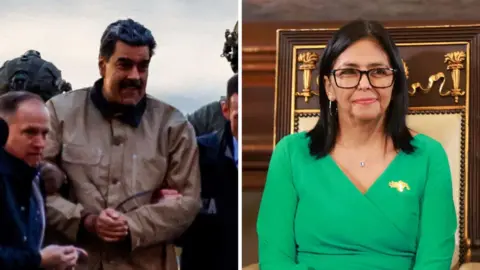
Rodríguez, 56, described the arrest of Maduro as a “kidnapping” and said she took office with deep personal pain. She accused the United States of carrying out an unlawful military attack and pledged to defend Venezuela’s sovereignty.
Maduro Appears in US Court
Just hours before Rodríguez was sworn in, Maduro appeared in a federal court in New York. During the hearing, he insisted that he remains the legitimate president of Venezuela.
Maduro pleaded not guilty to four major charges, including drug trafficking, terrorism-related offences, and illegal possession of heavy weapons. US prosecutors accuse him of leading a criminal network involved in cocaine smuggling and armed violence.
The hearing lasted about 30 minutes and was marked by tension. At one point, a member of the public shouted accusations at Maduro in Spanish. Maduro responded by calling himself a “kidnapped president” and a “prisoner of war.”
He was later escorted out of the courtroom in handcuffs, walking behind his wife as they were led through a back exit.
“I am a decent man. I am still president of my country,” Maduro said during the hearing.
Judge Alvin Hellerstein interrupted the exchange, telling Maduro there would be a proper time and place to raise political arguments.
Strong Reaction at the United Nations
The situation also sparked urgent debate at the United Nations. Before Maduro’s court appearance, the UN Security Council held an emergency meeting to discuss the events in Venezuela.
Venezuela’s ambassador to the UN, Samuel Moncada, accused the United States of carrying out an “illegitimate armed attack” without any legal basis.
In response, US ambassador Mike Waltz defended the operation. He said Maduro was not a legitimate leader and described him as a “fugitive from justice.” Waltz argued that Venezuela’s vast energy resources could not remain under the control of an illegitimate government.
The US described the operation as a “surgical law enforcement action” rather than an invasion.
Details of the US Operation
US officials said the operation involved more than 150 aircraft and over 200 US personnel. The mission resulted in the capture of Maduro and Flores, who were flown to the United States shortly after being detained.
Former US President Donald Trump, speaking hours after the operation, said the United States would oversee Venezuela until what he called a “safe and orderly transition” could take place.
Trump later suggested that US oil companies would move into Venezuela to repair infrastructure and boost economic production.
Concerns Inside the US
The operation has drawn criticism from US lawmakers, including senior members of Congress.
After receiving a classified briefing, Senate Minority Leader Chuck Schumer said the administration’s plan for Venezuela was unclear and lacked detail.
“The plan is vague and based on wishful thinking,” Schumer said. He also warned that similar actions in other countries could harm US interests.
“When the United States engages in this kind of regime change, it often ends badly,” he added.
House Speaker Mike Johnson defended the operation, saying the US was not seeking regime change but rather a change in behavior by Venezuela’s leadership. He said the US had the right to act to protect its national security.
Johnson also pointed to economic pressure, including seized oil exports, as a tool to force political change.
Rodríguez Takes Office Amid Tension
Despite US statements, Maduro’s political allies remain in control inside Venezuela.
Delcy Rodríguez was sworn in during a packed parliamentary session attended by lawmakers and supporters. Thousands of people gathered outside the Federal Legislative Palace to show support for Maduro, Flores, and the new interim president.
Speaking after taking the oath, Rodríguez said she accepted the role “with pain” because of the suffering caused by what she described as illegal foreign aggression.
She promised to protect peace, stability, and social order in Venezuela. She also said her government would focus on maintaining economic and emotional calm among the population.
“We will guarantee peace and tranquillity for our people,” Rodríguez said.
Warning From Trump
In comments to US media after it became clear Rodríguez would take office, Trump issued a warning to her government. He said Rodríguez could face serious consequences if she failed to cooperate with US demands.
“She could pay a very big price,” Trump said.
Despite the warning, Rodríguez indicated her government was open to limited cooperation with the United States, as long as it respected international law.
“We invite the US government to collaborate with us on an agenda of cooperation aimed at shared development,” she said.
Support From Maduro’s Family
During the National Assembly session, lawmakers also heard from Maduro’s son, who voiced strong support for his parents.
He told the assembly that his parents would return to Venezuela and pledged full support for Rodríguez’s interim leadership.
What Happens Next
Maduro’s next court hearing in the United States has been scheduled for 17 March. Legal experts say the case could take months or even years to resolve.
Meanwhile, Venezuela remains deeply divided. Supporters of Maduro see the events as foreign interference, while critics argue his arrest marks a turning point for the country.
As the political and legal battles continue, the future of Venezuela remains uncertain, with global attention focused on both Washington and Caracas.