

In a move that has drawn both political attention and legal scrutiny, U.S. President Donald Trump has formally placed his name on the United States Institute of Peace (USIP) building in Washington, D.C. The change comes just days before Trump is set to host the presidents of Rwanda and the Democratic Republic of Congo (DRC) for the signing of a U.S.-brokered peace agreement.
The newly updated signage now reads “Trump United States Institute of Peace,” marking the latest attempt by the administration to reshape the identity and operations of the institution.
A Symbolic Renaming Before High-Profile Peace Talks
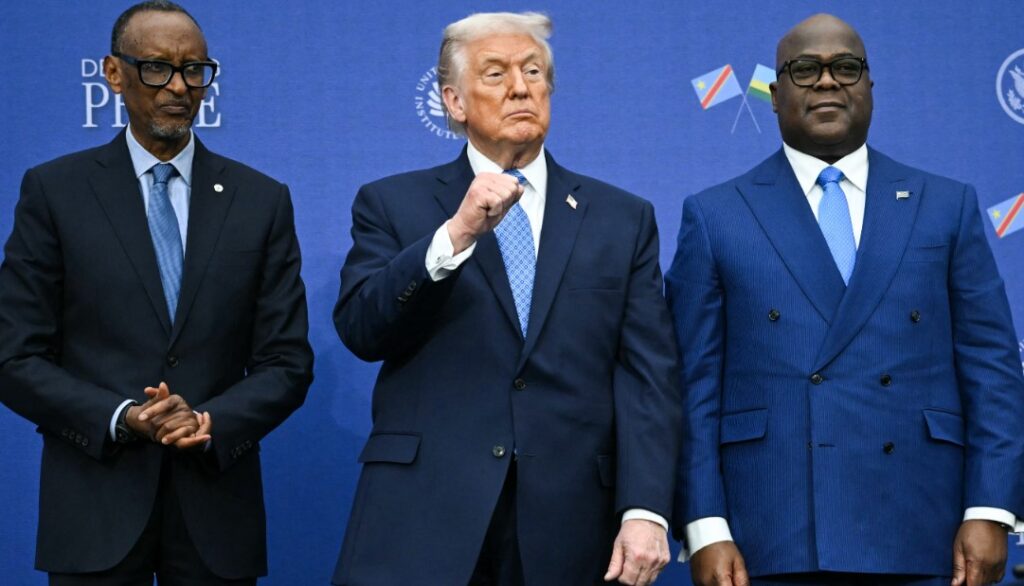
The renaming took effect shortly before the scheduled peace talks between Rwanda’s President Paul Kagame and DRC’s President Félix Tshisekedi. The meeting, held inside the building whose mission historically centered on conflict resolution and diplomacy, aims to finalize a regional peace accord backed by the United States.
The State Department announced the change on X, stating that Trump’s name was added to “reflect the greatest dealmaker in our nation’s history.”
At Thursday’s event, Trump publicly thanked Secretary of State Marco Rubio for the decision, calling it a “great honor.”
A Nonprofit Under Federal Seizure
The renaming is the latest chapter in a controversial saga. In March, Trump’s newly created Department of Government Efficiency (DOGE) seized control of the USIP, dismissed the nonprofit’s staff, and installed political appointees to run the institution.
A federal judge later ruled the takeover unlawful, describing it as a “gross usurpation of power,” but the decision was paused by an appeals court, enabling DOGE to maintain operational control.
According to former staffer Liz Callihan, the building has remained “largely empty” since mid-summer, with only a small team of facilities and operations employees continuing to work inside.
Legal Questions Intensify Over Authority
The USIP was created by Congress in 1984 as an independent, nonpartisan nonprofit, not a federal agency. Its mandate and governance structure are protected by statute, raising major questions about whether a sitting U.S. president has the authority to fire its employees, replace its leadership, or rename the institution.
These legal issues are central to an ongoing lawsuit currently under consideration by an appeals court.
Adding to the tension, the institute’s Wikipedia page was briefly edited to describe it as “an American institute that supports the Executive Branch,” a claim inconsistent with its legally independent status.
When asked about the decision to display Trump’s name on the building, White House spokesperson Anna Kelly said the institute had been “renamed for the president,” but did not specify the legal process behind the change.
A Building With a New Name, But Unsettled Future
While the Trump administration insists the renaming reflects the president’s diplomatic achievements, critics view it as another example of executive overreach and the politicization of historically nonpartisan institutions.
With the building now carrying the president’s name and the Rwanda–Congo peace signing taking place within its walls, the future of the institute , its leadership, mission, and legal structure remains uncertain.
As the appeals court deliberates, the question persists: Can a U.S. president unilaterally reshape an independent institution founded by Congress?
For now, the building stands renamed, its purpose reshaped, and its role in American diplomacy placed squarely in the center of political and legal debate.