
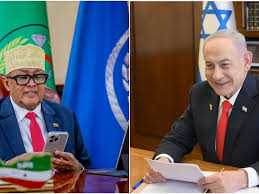
Somalia has taken the lead in a growing international backlash against Israel’s decision to recognise Somaliland as an independent state, a move that has triggered sharp diplomatic reactions across Africa, the Middle East, and beyond. Somali officials say the decision violates international law, undermines Somalia’s sovereignty, and risks destabilising an already fragile region.
In a statement released on Friday, the office of the Somali Prime Minister said Somaliland is an integral, inseparable, and inalienable part of Somalia’s sovereign territory. The government firmly rejected Israel’s recognition, calling it unlawful and demanding that the decision be reversed without delay.
“This action represents a clear violation of Somalia’s territorial integrity and international legal principles,” the statement said. “Somalia will not accept any attempt to alter its borders through unilateral recognition.”
Growing International Opposition
Somalia’s position has received strong support from several international and regional organisations. The African Union (AU) and the Arab League both issued statements condemning Israel’s move. They warned that recognising Somaliland could set a dangerous precedent by encouraging secessionist movements and weakening the principle of territorial unity across Africa.
Countries including Nigeria, Egypt, and several Arab states also expressed concern, saying the decision threatens international peace and security. Diplomats from these countries stressed that any change to Somalia’s borders must be decided through dialogue and in line with international law, not through outside recognition.
Officials at the African Union said they remain committed to Somalia’s unity and sovereignty, which has long been recognised by the United Nations and the broader international community.
Somaliland’s Unrecognised Status
Somaliland declared independence from Somalia in 1991, following the collapse of the central government and years of civil war. Since then, the region has maintained relative stability compared to much of southern Somalia. It has its own elected government, security forces, and currency, and regularly holds local elections.
Despite these developments, no member of the United Nations has formally recognised Somaliland as a sovereign state. The international community continues to view it as part of Somalia, in line with borders inherited at independence.
Somalia has repeatedly argued that recognition of Somaliland would weaken efforts to rebuild the country after decades of conflict and could encourage further fragmentation.
Israel’s Strategic Calculations
Israel has not issued a detailed public explanation for its recognition of Somaliland, but analysts believe the decision is linked to regional strategy and security interests. Somaliland’s location along the Gulf of Aden, near major global shipping routes, makes it strategically important.
Some experts suggest Israel is seeking stronger diplomatic and security ties in the Horn of Africa as part of a broader effort to counter regional rivals and expand its influence beyond the Middle East.
However, critics say the move ignores international norms and risks inflaming tensions in a region already facing political instability, climate challenges, and security threats.
Gaza War and Displacement Proposals
The controversy has been further intensified by reports linking Somaliland to proposals involving displaced Palestinians from Gaza. Following Israel’s recent war in Gaza, millions of Palestinians were forced to flee their homes, triggering one of the region’s worst humanitarian crises.
In March, investigative reports revealed that Israel and the United States had contacted officials in Somaliland with proposals to relocate displaced Palestinians to the region. According to the reports, the offers included financial assistance, diplomatic recognition, and security cooperation.
The idea was met with immediate outrage.
Palestinian leaders strongly rejected the proposals, calling them an attempt to permanently remove Palestinians from their land. Human rights groups and international legal experts said such a move would violate international humanitarian law, including the prohibition against forced population transfer.
Several organisations warned that relocating Palestinians without their consent could amount to crimes against humanity and ethnic cleansing.
Strong Rejection from the International Community
The proposals were widely condemned by countries across the Middle East, Africa, and Europe. The United Nations, along with multiple humanitarian agencies, reiterated that any solution to the Gaza crisis must respect Palestinian rights and international law.
Somalia also rejected any suggestion that Somaliland could be used for resettlement purposes. Somali officials said the proposals further highlight the dangers of recognising Somaliland without the consent of Somalia’s federal government.
“This is not only a matter of borders,” a Somali diplomat said. “It is about protecting international law and preventing forced displacement of vulnerable populations.”
Somalia’s Diplomatic Push
In response to Israel’s recognition, Somalia has launched a diplomatic campaign to rally international support. Officials in Mogadishu have engaged with regional partners, the United Nations, and major global powers to reinforce Somalia’s position.
The Somali government has formally demanded that Israel withdraw its recognition of Somaliland and respect Somalia’s sovereignty. It has also warned that continued recognition could damage diplomatic relations.
Somalia’s leaders say they are committed to peaceful dialogue but will not compromise on the country’s territorial unity.
A Sensitive Moment for the Horn of Africa
The dispute comes at a sensitive time for the Horn of Africa, a region facing overlapping crises, including armed conflict, political transitions, drought, and economic hardship. Analysts warn that diplomatic disputes over recognition could worsen instability if not handled carefully.
For now, the international community continues to recognise Somalia as a single sovereign state, with Somaliland remaining unrecognised despite its decades-long quest for independence.
As tensions rise, Somalia’s leadership has made clear that it will continue to oppose any move that threatens its territorial integrity, while urging global powers to act responsibly and uphold international law.