
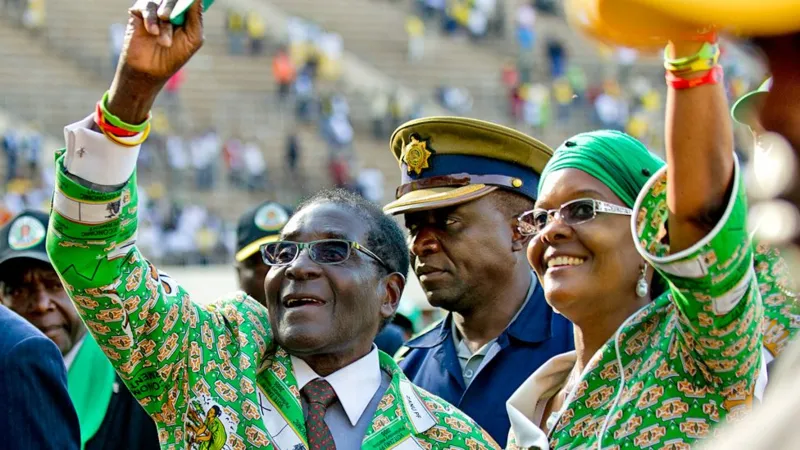
Zimbabwe’s former president Robert Mugabe has been named in newly released files linked to disgraced US financier Jeffrey Epstein. The documents, released by the US Department of Justice, include emails and unverified testimony that suggest Epstein may have explored possible financial or advisory links connected to Mugabe while he was in office.
Being named in the files does not imply guilt or wrongdoing. However, the disclosures have renewed scrutiny of Epstein’s global network and his claims of access to powerful figures.
The BBC has contacted the Mugabe family for comment. US authorities have also been asked to clarify the authenticity and context of the claims. Mugabe ruled Zimbabwe for nearly four decades before a military-backed intervention removed him from power in 2017. He died in September 2019 at the age of 95.
Emails suggest currency proposal discussions
At the centre of the disclosures is a 2015 email exchange between Epstein and Japanese entrepreneur Joichi “Joi” Ito. In the message, Epstein suggested approaching Mugabe to discuss a new currency for Zimbabwe. The country had abandoned the Zimbabwean dollar after hyperinflation rendered it worthless.
Epstein described Zimbabwe as a “fertile land for exploration” and claimed he could get Mugabe’s attention, despite admitting he was not close to him. The email appeared speculative and did not confirm any engagement. Still, it raised questions about Epstein’s ambitions in politically sensitive and sanctioned environments.
Unverified FBI testimony raises questions
The files also include FBI documents from 2017 containing testimony from a “human confidential source”. The source alleged that Epstein acted as a wealth manager for Russian President Vladimir Putin and made similar claims about Mugabe.
These statements remain unverified and lack support from public financial records. Legal experts warn that confidential source testimony often contains incomplete or inaccurate information. The FBI has not confirmed the claims.
Sanctions complicate alleged links
Any confirmed financial relationship between Epstein and Mugabe would have raised serious legal concerns. The US imposed sanctions on Mugabe in 2003, banning American citizens from conducting financial transactions with him.
As a US national, Epstein would have breached those sanctions if he had managed Mugabe’s wealth. Analysts say this legal context further weakens the credibility of the claims. So far, US authorities have not confirmed any sanctions violations.
Mugabe’s name appears repeatedly
Beyond the 2015 email, Mugabe’s name appears in other correspondence. One April 2012 email falsely claimed Mugabe was on his deathbed in Italy. The sender asked Epstein for contacts in Zimbabwe, citing potential business opportunities.
Days later, Mugabe returned from medical treatment in Singapore and appeared in public. He went on to lead Zimbabwe’s independence celebrations shortly after.
Allies question accuracy
A former Mugabe ally, speaking anonymously to the BBC, dismissed several claims in the files as inaccurate or fabricated. The ally cited factual errors, including the false death report, as evidence that Epstein’s network circulated unreliable information.
Observers note that Epstein often exaggerated his influence and access to world leaders. This pattern complicates efforts to separate fact from self-promotion.
Epstein’s network under scrutiny
Epstein, a wealthy financier, built ties with politicians, academics, and business leaders worldwide. He was convicted in 2008 of soliciting sex from a minor and later faced federal sex-trafficking charges. Authorities found him dead in a New York jail in August 2019 in what was ruled a suicide.
Court-ordered releases of documents have since exposed the scale of his contacts, reigniting debate over how he gained such access.
Joi Ito and MIT fallout
Joichi Ito resigned as head of the MIT Media Lab in September 2019 after reports revealed the lab had accepted donations linked to Epstein. The scandal sparked wider discussions on donor vetting and institutional ethics. Ito has not commented publicly on the Mugabe-related emails.
Zimbabwe’s ongoing economic challenges
The renewed focus on Mugabe comes as Zimbabwe continues to struggle with economic instability rooted in decisions made during his rule. After abandoning its currency in 2009, the country relied heavily on the US dollar.
Several attempts to reintroduce a local currency failed. A gold-backed currency, the ZiG, introduced two years ago, has shown some success after a difficult start. Still, many Zimbabweans prefer the US dollar due to lingering mistrust.
What the files do — and do not — show
Experts stress that inclusion in the Epstein files does not prove wrongdoing. The documents mix verified records with private emails and untested claims. In Mugabe’s case, no direct evidence confirms financial dealings with Epstein.
As journalists continue to examine the files, more details may emerge. For now, the disclosures add another layer to the global fallout from Epstein’s activities, while leaving key questions unanswered about his alleged connections in Africa.