

Venezuelan President Nicolás Maduro has been at the centre of political controversy for more than a decade. Since taking power in 2013, he has faced repeated accusations of repressing opposition parties, limiting free speech, and using state power to silence critics. Many Venezuelans, along with several foreign governments, believe his leadership has weakened democratic institutions and worsened the country’s economic crisis.
Tensions increased further after Venezuela’s disputed 2024 presidential election. Opposition groups and international observers claimed the vote lacked transparency and fairness. As a result, many countries refused to recognise Maduro’s victory, calling his continued rule illegitimate.
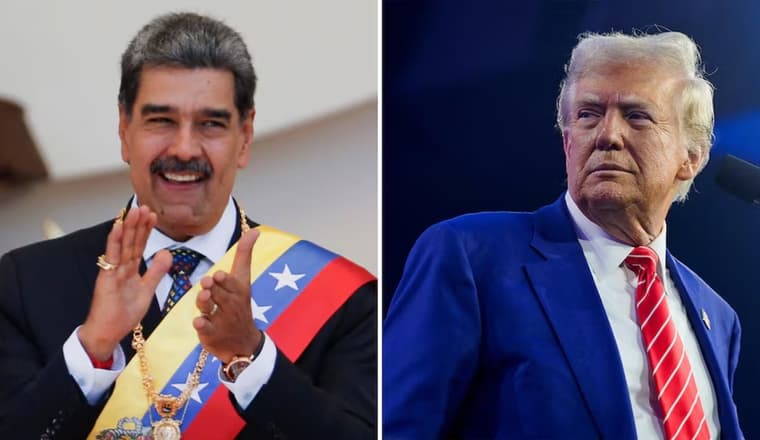
That long-running conflict reached a dramatic turning point early Saturday morning, when the United States carried out a secret operation inside Venezuela that led to Maduro’s arrest.
A Dramatic Overnight Operation
According to US officials, special forces launched a coordinated operation in the early hours of Saturday. Maduro and his wife, Cilia Flores, were captured at their residential compound and flown to the United States.
At the same time, US forces carried out strikes on several Venezuelan military bases. The operation was described by American officials as carefully planned and targeted, aimed at preventing resistance and ensuring a swift extraction.
Soon after arriving in the US, Maduro and Flores were formally charged with drug trafficking and weapons-related offences. American prosecutors allege that Maduro played a central role in a drug network that sent large quantities of narcotics to the United States over several years.
The couple are expected to appear before a federal court in New York on Monday.
Maduro Denies All Charges
Maduro has strongly denied the accusations against him. He insists he is not a drug trafficker and rejects claims that he led or supported any criminal organisation.
In statements released through Venezuelan state media, Maduro accused the United States of using its long-running “war on drugs” as a cover for political goals. He said Washington’s real intention was to remove him from power and gain greater influence over Venezuela’s vast oil reserves.
Venezuela has some of the largest proven oil reserves in the world, and control over those resources has long been a point of tension between Caracas and Washington.
Conflicting Accounts of Casualties
US officials say the operation was successful and that no American soldiers were injured or killed. They have emphasised that the mission was limited in scope and focused on arresting Maduro.
However, Venezuela’s Defence Minister, Vladimir Padrino, gave a very different account. He said a “large part” of Maduro’s security team was killed during the operation. He also claimed that Venezuelan soldiers and innocent civilians lost their lives when US forces struck military installations.
The exact number of casualties remains unclear, and independent verification has not been possible. The conflicting statements have added to confusion and anger inside Venezuela, where protests and public unrest are growing.
US Officials Defend the Mission
Senior US lawmakers from the ruling administration have defended the operation. Senator Marco Rubio, speaking to several American television networks, said congressional approval was not required.
Rubio argued that the action was not an invasion or a traditional military attack. Instead, he described it as a “law enforcement operation” aimed at arresting an individual facing criminal charges.
He said Maduro was arrested on the ground by FBI agents, with military forces providing security support. According to Rubio, notifying Congress in advance would have risked leaks that could have endangered the mission.
“You can’t notify Congress of something like this,” Rubio said. “It will leak.”
Rubio also rejected claims that the operation was about recognising a new Venezuelan leader. When asked whether the US considers another figure as the country’s legitimate president, he said the US does not recognise the current Venezuelan regime as legitimate at all.
“This is not about who the president is,” Rubio said. “It’s about enforcing the law.”
Democrats Condemn the Operation
Many Democratic lawmakers have strongly criticised the administration’s actions, saying the operation crossed legal and constitutional lines.
House Minority Leader Hakeem Jeffries said the mission went far beyond a simple drug enforcement effort.
“This was not just a narcotics operation,” Jeffries said in an interview with NBC’s Meet the Press. “This was an act of war.”
Jeffries pointed to reports suggesting that the operation involved elite military units, including Delta Force, along with thousands of troops, more than 150 aircraft, and naval ships positioned off the coast of South America.
Jim Himes, the senior Democrat on the House Intelligence Committee, said he received no briefing before the operation took place.
“There was zero outreach,” Himes said. “No Democrat that I’m aware of was consulted.”
Legal and Constitutional Concerns
Senate Minority Leader Chuck Schumer also questioned the legality of the operation. Speaking to ABC’s This Week, Schumer said that while he views Maduro as a dangerous and abusive leader, the US must still follow the rule of law.
“You don’t treat lawlessness with other lawlessness,” Schumer said.
He warned that past US efforts to remove foreign governments through military force had often ended badly. According to Schumer, such actions have cost American lives and drained public funds without delivering long-term stability.
Schumer and Jeffries both said they would support a resolution in Congress that would block any further US military action in Venezuela unless lawmakers give formal approval.
If passed, such a resolution would significantly limit the president’s ability to act unilaterally in the region.
International Reaction and Condemnation
The US operation has also drawn criticism from several foreign governments, particularly in Latin America and Europe.
In a joint statement, Brazil, Chile, Colombia, Mexico, Uruguay, and Spain condemned the action. They said the use of military force inside Venezuela sets a dangerous precedent and threatens regional peace.
The statement warned that such operations increase the risk to civilians and could lead to wider instability across South America.
“These actions endanger the civilian population and undermine international law,” the statement said.
Some governments expressed concern that the operation could encourage other powerful nations to carry out similar actions in weaker states, bypassing diplomatic and legal processes.
Uncertain Future for Venezuela
Inside Venezuela, the situation remains tense. Supporters of Maduro have called the arrest an act of foreign aggression, while opposition figures see it as the removal of a leader they believe ruled illegitimately.
Questions remain about who will govern Venezuela in the short term and how power will be transferred. The US has not announced any plans to install or recognise a new government, adding to uncertainty.
Economists and regional analysts warn that instability could further damage Venezuela’s fragile economy, which has already been weakened by years of inflation, shortages, and international sanctions.
A Defining Moment
The arrest of Nicolás Maduro marks one of the most dramatic US actions in Latin America in decades. Supporters of the operation argue it sends a strong message against corruption and drug trafficking. Critics warn it risks escalating conflict, undermining international law, and setting a dangerous example.
As Maduro prepares to appear in a US court, the political, legal, and diplomatic consequences of the operation are only beginning to unfold. Whether the move leads to accountability, chaos, or deeper divisions remains uncertain.
One thing is clear: the events of Saturday have reshaped the future of Venezuela and raised serious questions about the limits of US power abroad.