
Uganda is one of the youngest nations in the world. More than half of its people are under the age of seventeen. Yet, as the country prepares for another presidential election, leadership remains in the hands of an eighty one year old president, Yoweri Museveni.
This contrast has created a national debate. Many Ugandans now ask whether a youthful population can continue to be governed by leaders who came to power decades ago.
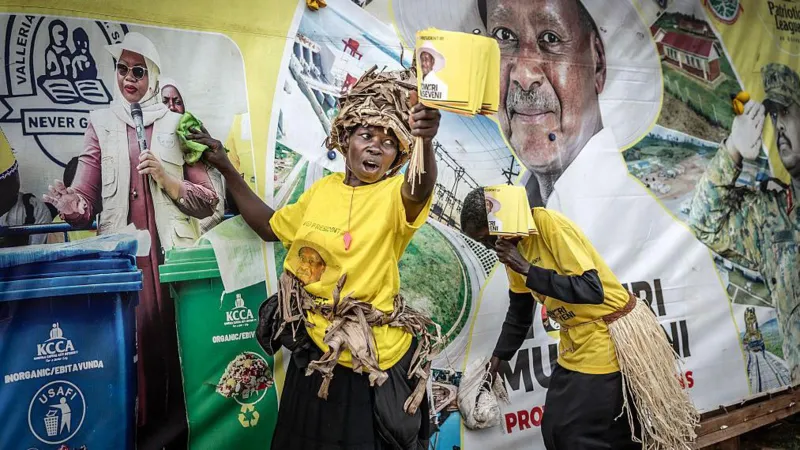
Youth Energy Shapes the Campaign
Across towns and villages, young people dominate political rallies. They sing, chant, film speeches, and share messages online. In fact, youth participation has become the heart of Uganda’s political atmosphere.
At an opposition rally, Steven Bagasha Byaruhanga praised Bobi Wine as a symbol of hope. According to him, Bobi Wine represents fresh leadership and new ideas.
Meanwhile, another young voter, Ndyasima Patrick, defended President Museveni. He argued that Museveni has protected Uganda for many years and deserves more time.
Together, these views show how deeply divided young voters have become.
A Familiar Political Contest
Once again, President Museveni faces Bobi Wine, whose real name is Robert Kyagulanyi. This is a repeat of the two thousand twenty one election.
Museveni presents himself as a leader of stability and experience. Bobi Wine, however, speaks as a voice of freedom and reform.
Although they differ in age and background, both rely heavily on young voters.
Two Competing Visions
The ruling party promotes continuity. It highlights peace, infrastructure, and refugee protection. Supporters argue that Uganda has improved under Museveni’s leadership.
In contrast, the opposition focuses on unemployment, corruption, and police brutality. According to Bobi Wine, stability without justice is not true progress.
As a result, youth voters must choose between security and transformation.
A Young Country With Old Leadership
Uganda reflects a wider African pattern. Many countries have youthful populations but ageing leaders.
Over time, term limits have been removed. Institutions have weakened. Political power has remained concentrated.
Because of this, frustration has grown among young people who feel excluded.
The Job Crisis
One major issue is unemployment.
Every year, thousands graduate from schools and universities. However, job opportunities remain limited.
Consequently, many young people feel hopeless. Others accept informal work with low pay.
For many families, politics has now become a question of survival rather than ideology.
Protest and Pressure
When young people protest, security forces often respond with force. Arrests, tear gas, and intimidation are common.
Instead of reducing anger, these actions increase resentment.
Therefore, youth voices have become louder, not quieter.
Influence From the Region
Uganda is not alone in this struggle.
In Kenya, youth protests have shaken politics. In Tanzania, activism is rising. Mozambique and Madagascar have also experienced unrest driven by young people.
Across Africa, youth are demanding accountability.
Museveni’s Strengths
Supporters credit Museveni for stability.
They recall the violence before nineteen eighty six. They point to improved roads, education, and diplomacy.
For many rural communities, he remains a symbol of order.
Museveni’s Weaknesses
Critics, however, argue that long rule has weakened democracy.
They accuse the government of limiting press freedom and controlling courts.
Moreover, they fear political power is slowly becoming a family affair.
Bobi Wine’s Appeal
Bobi Wine connects strongly with young voters.
His music background helps him communicate with ordinary people.
He speaks openly about injustice and inequality.
Still, some voters worry about his lack of experience. Supporters reply that leadership must begin somewhere.
Fear Versus Hope
Some Ugandans fear that change may bring instability.
Others believe that without change, Uganda will remain stuck.
This tension shapes every political conversation.
Youth at the Center
Uganda’s youth are no longer silent.
They vote.
They organise.
They debate.
They influence families.
They dominate digital platforms.
Because of this, the election outcome will depend greatly on youth participation.
What Is at Stake
This election is not only about two leaders.
It is about institutions.
It is about opportunity.
It is about freedom.
It is about dignity.
Most importantly, it is about Uganda’s future.
Global Attention
The world is watching Uganda closely.
Foreign governments and human rights groups are monitoring events.
Uganda’s stability affects the entire East African region.
Therefore, the election result carries regional importance.
The Youth Decision
Young Ugandans now face a historic choice.
They must decide whether experience matters more than renewal.
They must also decide whether stability outweighs opportunity.
Ultimately, they must choose what kind of country they want to inherit.
Final Reflection
Uganda stands at a crossroads.
A nation with millions of young citizens is deciding whether to trust an elderly leader again.
This choice reflects a deeper struggle between tradition and transformation.
Regardless of the result, one truth is clear.
Uganda’s youth have already changed politics.
Their voices are no longer invisible.
And the future, sooner or later, will belong to them.