
At least 13 people lost their lives and nearly 100 others were injured after a passenger train derailed in Mexico’s south-western state of Oaxaca, according to officials from the Mexican navy. The accident occurred on a key railway line that connects the Gulf of Mexico to the Pacific Ocean, raising serious concerns about rail safety on one of the country’s most important transport routes.
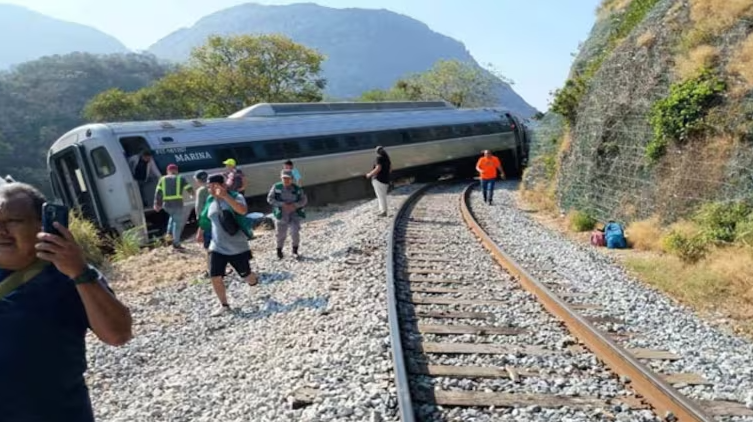
The train was carrying 241 passengers and nine crew members when it left the tracks near the town of Nizanda. Officials said the derailment happened as the train was rounding a curve, causing multiple cars to tip over and slide off the rails. Some carriages reportedly tilted dangerously toward a nearby cliff, making rescue efforts more difficult.
Casualties and Medical Response
The Mexican navy confirmed that 98 people were injured in the crash. Of those, 36 were taken to hospitals for further treatment, while others received medical care at the scene. President Claudia Sheinbaum said that five of the injured remain in serious condition, and doctors are closely monitoring their recovery.
Emergency services, including navy personnel, firefighters, and medical teams, were deployed quickly after the derailment. Ambulances transported the wounded to nearby hospitals, while rescue workers helped passengers exit the damaged train cars.
Videos and photos from the scene showed injured passengers being carried on stretchers, while others walked away from the wreckage in shock. Many survivors were seen helping fellow passengers, offering water and comfort as they waited for assistance.
Rescue Operations in Challenging Terrain
Rescue efforts were complicated by the rough and uneven terrain surrounding the crash site. The railway line passes through a hilly area, and parts of the train came to rest close to the edge of a slope. Officials said this required rescuers to move carefully to avoid further injuries.
Despite these challenges, authorities said all passengers and crew were safely evacuated within hours of the crash. Temporary shelters were set up to provide food, water, and medical support for those affected.
Government Response and Investigation
President Sheinbaum expressed her condolences to the families of those who died and promised full support for the injured. She also announced that senior government officials, including the Secretary of the Navy, were travelling to Oaxaca to oversee rescue operations and coordinate the government’s response.
Mexico’s Attorney General’s Office confirmed that a formal investigation has been launched to determine the cause of the derailment. While early information suggests the train left the tracks while navigating a bend, officials said it was too early to rule out other factors such as track conditions, speed, or mechanical issues.
The investigation will include inspections of the railway line, the train’s mechanical systems, and operational procedures followed by the crew.
About the Interoceanic Train
The derailed train is part of the Interoceanic Corridor, a major infrastructure project designed to improve transport between Mexico’s Pacific and Gulf coasts. The route links the port city of Salina Cruz in Oaxaca with Coatzacoalcos in Veracruz and is seen as an alternative trade route to the Panama Canal.
According to the navy, the train involved in the accident had two locomotives and four passenger cars. Mexico’s navy currently operates the national railway network as part of broader transport and development efforts.
Safety Concerns Raised
The crash has renewed public debate about railway safety in Mexico, particularly on routes that pass through mountainous regions. Experts say regular maintenance, speed controls, and modern safety systems are essential to prevent accidents on curved or elevated tracks.
Local residents and passenger groups have called for greater transparency in the investigation and stronger safety measures to protect travelers in the future.
Ongoing Support for Victims
Authorities said counseling services and financial assistance would be provided to victims and their families. Officials also pledged to keep the public informed as more details emerge from the investigation.
As Mexico mourns the lives lost in this tragic incident, attention is now focused on ensuring accountability, improving rail safety, and preventing similar accidents from happening again.